THE HEDBERG FRAMEWORK PRACTITIONER CERTIFICATION
Turn Complex Cases into a Coherent Clinical Sequence
Learn a whole-person clinical reasoning system grounded in psychoneuroimmunology that helps you connect foundations, regulation, and physiology; distinguish what is driving the case from what is downstream; and choose the next highest-leverage step.
When everything seems connected, where do you begin?
Complex chronic illness rarely fits a single-pathway model. A patient may present with fatigue, brain fog, sleep disruption, gut symptoms, dysautonomia, immune reactivity, pain, hormonal changes, environmental burdens, trauma, and a long list of laboratory findings—all at the same time.
Functional medicine gives practitioners valuable tests, mechanisms, interventions, and protocols. But more information does not automatically reveal the hierarchy of the case.
Without a coherent map:
Every abnormality can appear equally important.
The next intervention may be chosen by urgency, habit, a new test, or patient pressure.
Regulatory capacity may be overlooked while treatment intensity increases.
The patient’s story, relationships, environment, agency, and purpose can disappear behind the data.
Care can become more fragmented even when each individual intervention is reasonable.
The Hedberg Framework was created to organize the whole case before choosing the next intervention.
A clinical framework large enough for the whole person
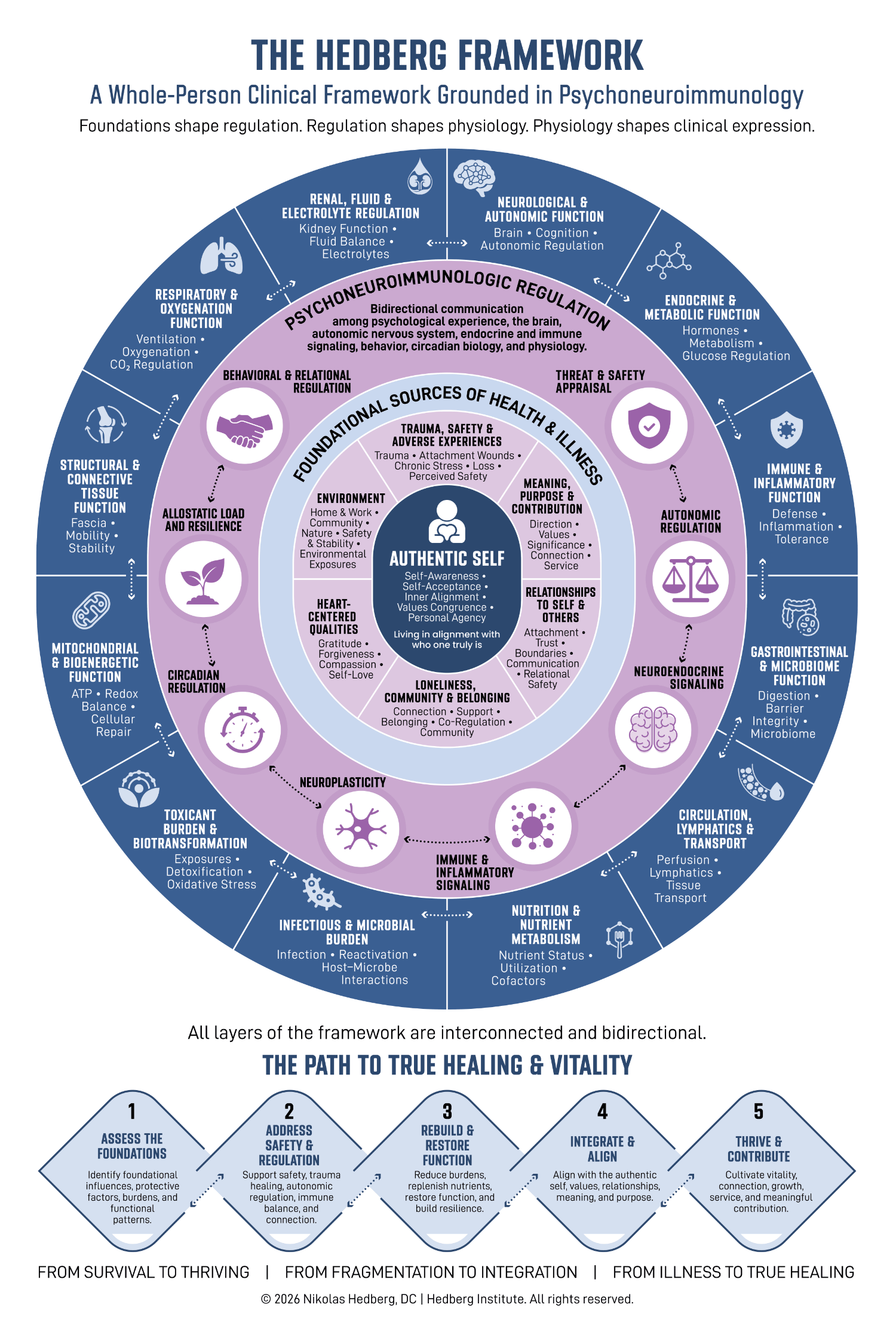
The Hedberg Framework is a whole-person clinical framework grounded in psychoneuroimmunology. It connects the patient’s lived foundations, regulatory state, and functional physiology in one bidirectional system.
At the center is the Authentic Self: identity, agency, values, inner alignment, and the life the patient is trying to reclaim. Surrounding it are the
Foundational Sources of Health and Illness—the experiences and conditions that repeatedly signal safety, threat, connection, depletion, meaning, or nourishment.
Psychoneuroimmunologic regulation forms the bridge between lived experience and biology through threat and safety appraisal, autonomic regulation, neuroendocrine and immune signaling, circadian biology, neuroplasticity, behavior, relationships, allostatic load, and resilience.
The 12 Functional Domains organize the outer physiological expression of the case. The five-step Path to True Healing & Vitality converts the map into a practical sequencing model.
Foundations shape regulation. Regulation shapes physiology. Physiology shapes clinical expression.
What the framework is — and is not.
The Hedberg Framework is:
A clinical reasoning and case-organization system
A whole-person map that integrates lived context and physiology
A method for determining capacity, leverage, and sequence
A structure for using tests, protocols, and interventions more coherently
The Hedberg Framework is not:
A rigid protocol applied identically to every patient
A replacement for diagnosis, medical judgment, or referral
A promise that every symptom has one root cause
A license to practice outside your professional scope
What will you be able to do?
By completing the certification and its clinical applications, you will learn to:
Build a coherent whole-person case map from the history, timeline, symptoms, labs, examination, context, and response patterns.
Distinguish primary drivers, mediators, amplifiers, perpetuating factors, and downstream effects.
Assess foundational influences, protective factors, active burdens, and the patient’s current regulatory capacity.
Use psychoneuroimmunology to connect threat and safety appraisal with autonomic, endocrine, immune, behavioral, circadian, and physiological patterns.
Organize complex physiology through the 12 Functional Domains.
Prioritize what must be stabilized, what can wait, and what may create the greatest leverage.
Sequence care through the five-step Path to True Healing & Vitality.
Communicate a coherent plan that patients can understand, participate in, and revisit as capacity changes.
Use response to treatment as new information that refines the map rather than as a simple success-or-failure verdict.
The goal is better clinical reasoning—not simply more protocols.
The Path to True Healing & Vitality
The framework becomes practical when it guides sequencing. Patients may move back and forth between the steps, but the pathway helps you identify what the system needs now.
Assess the Foundations — Identify foundational influences, protective factors, burdens, and functional patterns.
Address Safety & Regulation — Support safety, trauma healing, autonomic regulation, immune balance, rhythm, and connection.
Rebuild & Restore Function — Reduce burdens, replenish nutrients, restore function, and build resilience.
Integrate & Align — Align progress with the authentic self, values, relationships, meaning, and purpose.
Thrive & Contribute — Cultivate vitality, connection, growth, service, and meaningful contribution.
The endpoint is not merely fewer symptoms. The deeper aim is the capacity to live, love, create, serve, and contribute.
What practitioners say about learning with Dr. Hedberg
“For any practitioner wishing to get straightforward and practical functional medicine education I highly recommend Dr. Nik Hedberg. I have been impressed by his practical approach to patient care, and dedication to evidence based treatments. I found his case studies incredibly useful in advancing my knowledge of functional medicine. Dr. Hedberg has also helped me to better appreciate the role of trauma as an underlying mechanism for illness and implementing this aspect of care with my patients has been very helpful.”
Joe Mather, MD, MPH
“Dr. Hedberg has an outstanding program with strong fundamentals, the application of the information is patient focused and very provider friendly. Thorough patient assessment tools and treatment plans that work extremely effective at getting results. The bonus I feel in this program is all the clinical pearls that are shared throughout each module. I thank you and my patients thank you! Keep sharing!”
Dr. Raymond Higby, DC
“The courses at the Hedberg Institute have been tremendously helpful and insightful. Doctor Hedberg has introduced several novel concepts to me that I haven’t seen anywhere else, and everything he teaches can be directly applied in a clinical setting. Everything I have learned has made me a more effective and confident functional medicine doctor.”
Dr. Jake Vonfeldt, DC, MS
A complete learning pathway from orientation to clinical integration
| Learning phase | What it develops |
|---|---|
| Orientation & Implementation | How the certification works, how to use the community and resources, expectations, certification requirements, and a baseline complex case to revisit throughout the program. |
| Framework Fundamentals | Whole-person clinical reasoning, the hierarchy of foundations, regulation, physiology, and clinical expression, plus drivers, mediators, amplifiers, downstream effects, and sequencing. |
| Authentic Self & Foundational Sources | Trauma and safety, meaning and purpose, relationships and belonging, environment, heart-centered qualities, agency, alignment, and their relationships with health and illness. |
| Psychoneuroimmunologic Regulation | Threat and safety appraisal, autonomic regulation, neuroendocrine and immune signaling, circadian biology, neuroplasticity, behavior, relationships, allostatic load, and resilience. |
| The 12 Functional Domains | A systematic language for organizing neurological, endocrine, immune, gastrointestinal, circulatory, nutritional, microbial, toxicant, mitochondrial, structural, respiratory, and renal patterns. |
| Clinical Methodology | The Path to True Healing & Vitality, clinical mapping, patient capacity, prioritization, sequencing, monitoring, and communication. |
| Clinical Mastery Tracks | In-depth application to gut, thyroid, infection-related illness, Long COVID and ME/CFS, mold and mycotoxins, MCAS and histamine, autoimmunity, and other complex chronic illness patterns included in the finalized curriculum. |
| Case Integration & Certification | Case studies, reasoning exercises, module assessments, final application, and certification requirements. |
Everything you need to learn, apply, and retain the methodology
Concise video lessons — Most core lessons are designed to be completed in approximately 5–12 minutes.
Clear required pathway — Core certification content is separated from optional deep dives and research resources.
Clinical case studies — See how the framework changes case organization, prioritization, and sequencing.
Clinical tools and worksheets — Apply the methodology in practice rather than only watching lectures.
Protocols and patient handouts — Use practical resources within the context of clinical reasoning and scope.
Research and references — Follow the scientific grounding behind major framework concepts and clinical topics.
Knowledge checks and assessments — Reinforce retrieval, application, and clinical reasoning.
Practitioner community — Ask questions, discuss cases appropriately, and learn with colleagues.
Live support — Monthly Zoom Q&A for cases and questions and a private Signal group for fast answers to your questions.
Certificate — Earn the Hedberg Framework Practitioner Certification after completing all stated requirements.
Designed for practitioners who
want to finish what they start
Long, undifferentiated course libraries make it difficult to maintain momentum. The certification is designed around a visible core pathway, concise lessons, active application, and clear next steps.
Most core lessons target approximately 5-15 minutes.
Learning units group related lessons into manageable blocks.
Brief knowledge checks reinforce recall and clinical use.
Case applications turn the framework into a working method.
Required material is clearly separated from optional depth.
The course always shows where you are and what to do next.
Learn the map by applying it
to real clinical complexity
Clinical reasoning is not learned through passive viewing alone. Throughout the certification, you will revisit cases and practice identifying the dominant layer, regulatory constraints, primary domains, patient capacity, highest-leverage next step, and sequence of care.
You will be asked to explain not only what you would do, but why it should come now—and what should not be prioritized yet.
Is this right for you?
This certification is designed for practitioners who:
Work with complex chronic illness or want to develop that capability.
Need a stronger hierarchy for cases involving multiple systems and competing priorities.
Want to integrate psychoneuroimmunology, relationships, environment, meaning, and physiology in a clinically disciplined way.
Value research, clinical experience, patient individuality, and thoughtful sequencing.
Want a methodology that can complement their existing functional or integrative medicine model.
This certification is not designed for:
Patients or members of the general public seeking personal medical advice.
Anyone seeking a credential that grants licensure or expands legal scope of practice.
Practitioners who only want disease-specific protocols without learning the reasoning that guides their use.
Anyone unwilling to consider the patient’s lived context, regulatory state, and capacity as part of clinical care.
Learn from Nikolas Hedberg
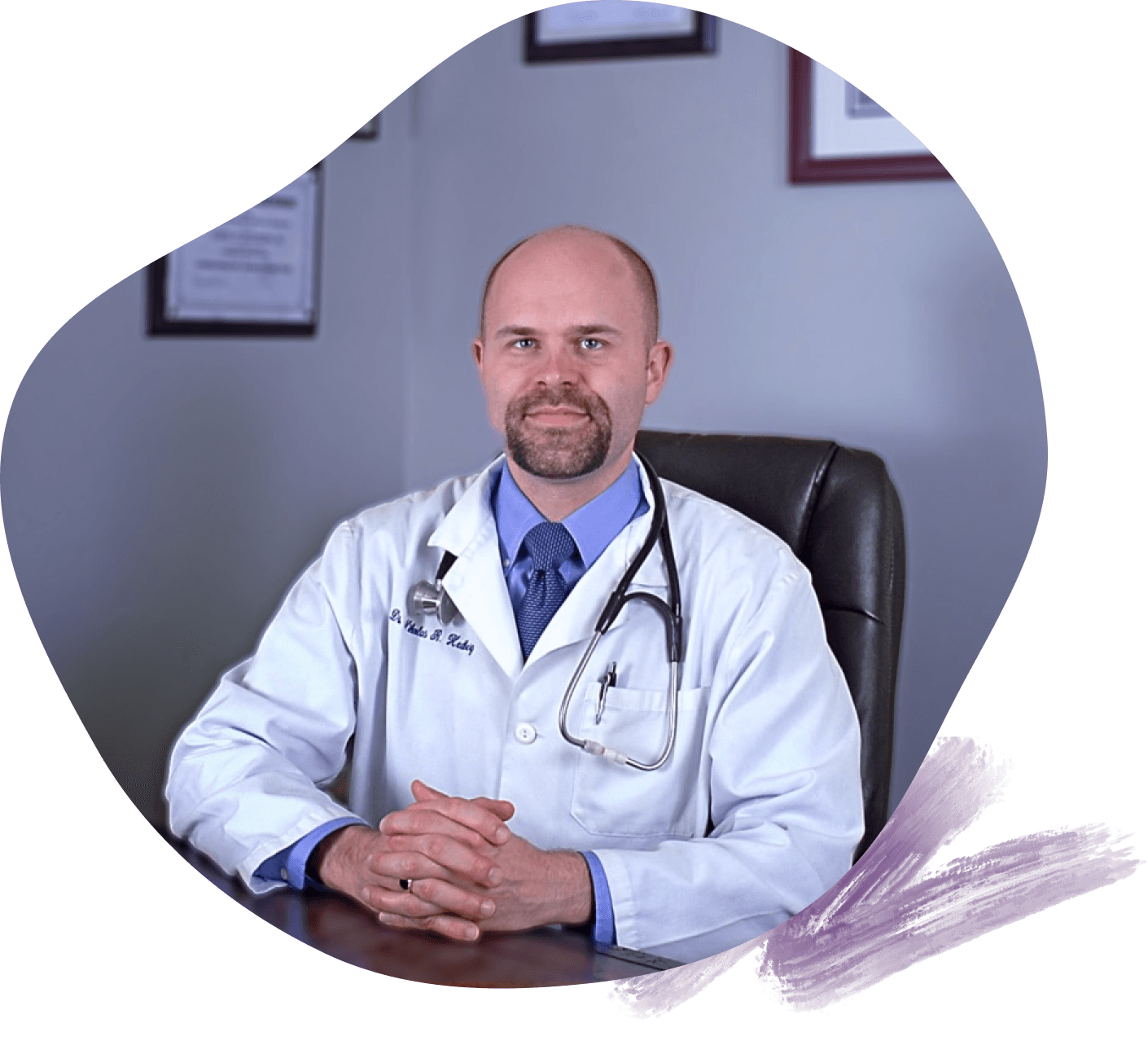
Dr. Nikolas Hedberg is a Chiropractic Physician, Board-Certified Chiropractic Internist, and Board-Certified in Nutrition. For more than 20 years, he has worked with complex chronic illness and educated practitioners in functional medicine.
His clinical and teaching experience includes Lyme disease and coinfections, autoimmune disease, mold and mycotoxin illness, mast cell activation syndrome, ME/CFS, Long COVID, gastrointestinal and thyroid disorders, and the interconnected patterns that make these cases difficult to organize.
The Hedberg Framework grew from a recurring clinical problem: practitioners often had excellent tools but lacked a sufficiently complete map for understanding the whole person, the system’s regulatory state, and the sequence in which care should unfold.
This certification is the culmination of that work—a clinical methodology intended to help practitioners move from fragmentation to integration and help patients move from survival toward true healing and vitality.
Hear From Fellow Practitioners
“I’m a practicing board certified gastroenterologist. I’m truly enjoying Dr Hedberg’s webinars. I like how he takes a deep dive into the pathophysiology and then gives objective options for treatments. Through his clinical experience and knowledge, he is able to provide a framework upon which practitioners can use to treat their own patients.”
Christian Turbide, MD, FRCPC
“Dr. Hedberg’s webinars and programs are a wealth of knowledge, and they have been a great help in moving us into a deeper understanding of Functional Medicine. With this information, our clinic has had a greater impact on the health and healing of our patients.
Joe Gitto, BA, DC, CFMP, FDN
“Dr. Hedberg’s webinars are powerful, practical and, I think, essential to all practitioners. He goes straight to the heart of the clinically relevant research, and in every webinar I have completed there are always therapeutic pearls that I can apply directly to my practice. I really appreciate his knowledge and teaching style.”
Gillian Martlew, ND
Become a Hedberg Framework Certified Practitioner
Develop a whole-person method for organizing complex chronic illness, identifying what matters most, and sequencing care with greater clarity.
Your enrollment includes:
The complete core certification curriculum
Clinical mastery training and case studies
Clinical worksheets, protocols, patient handouts, and implementation tools
Research references and optional deep dives
Module assessments and final certification requirements
Practitioner community access
Monthly Zoom Q&A for case reviews and questions and a private Signal group for fast answers to your questions
Lifetime access
Certificate of completion
7-Day Enrollment Assurance
Frequently Asked Questions
DC, ND, MD, DO, PA, Nurse Practitioner, Nurse, Pharmacist, PhD, Acupuncturist/DOM, Nutritionist, Registered Dietician, Dentist, Podiatrist, Herbalist, Health Coach
No. Protocols and clinical resources are included, but the central purpose is to strengthen clinical reasoning. You will learn how to determine when an intervention is appropriate, when it may be premature, and what should come first.
No. The program is educational. You are responsible for practicing within your professional license, training, jurisdiction, and ethical obligations, and for referring or collaborating when appropriate.
Most required lessons are designed to be concise, generally approximately 5–12 minutes. Longer case conferences, demonstrations, interviews, and research deep dives may be offered as optional or clearly labeled extended content.
[INSERT TOTAL ESTIMATED CORE HOURS, SUGGESTED WEEKLY PACE, AND COMPLETION WINDOW.]
Lifetime access.
Yes, there is a community forum, private Signal group, and Zoom meetings.
Complete all lessons and pass all quizzes and the final examination.
Not at this time.
The program integrates peer-reviewed research, established physiology, clinical experience, and transparent references. It also distinguishes scientific evidence, clinical interpretation, and areas where evidence is still developing.
Yes. The Hedberg Framework is designed as an organizing and sequencing system that can complement your existing diagnostic and therapeutic approach, within your professional scope.
No educational program can guarantee clinical outcomes. Patient response depends on many factors, including diagnosis, severity, context, adherence, access to care, practitioner judgment, and appropriate referral or collaboration.
Your next complex case does not need more fragmentation.
Learn a clinical methodology that connects the whole person, regulatory state, and functional physiology—then turns that understanding into a thoughtful sequence of care.
Framework first. Protocol second.